
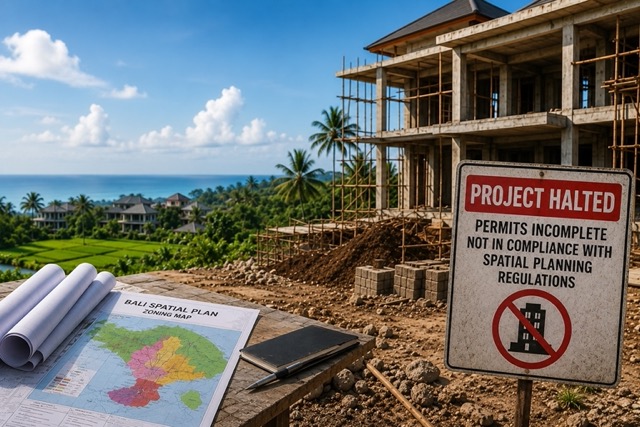
Why Are So Many Villa Projects in Bali Stalling? The Hidden Role of Zoning Regulations
Bali’s villa boom once looked unstoppable. Luxury villas were rising everywhere, investors rushed to buy land, and tourism kept driving demand higher. But behind the rapid growth, a different reality has started to emerge. Many villa projects across Bali are now delayed, abandoned, or unable to operate legally. Surprisingly, the biggest issue is often not funding or market demand , but zoning and spatial planning regulations. This article explores why more villa developments in Bali are running into trouble, how stricter land-use rules are reshaping the property market, and what investors need to understand before buying land in Bali today.
Why Are So Many Villa Projects in Bali Suddenly Stopping?
A few years ago, Bali felt like one giant construction site. New villas were appearing almost everywhere, from rice field areas to coastal cliffs and tourism hotspots.
Today, the situation is starting to change.
More and more villa projects are being delayed, paused halfway through construction, or quietly abandoned altogether. Some developments stop after the foundation stage. Others finish construction but struggle to obtain operational permits. Some owners eventually try to sell at a loss.
This phenomenon is becoming increasingly common in areas like Canggu, Uluwatu, Berawa, Ubud, and even parts of Denpasar.
Many people assume the problem is oversupply or slowing tourism demand. But the reality is far more complex.
One of the biggest reasons many villa projects in Bali are struggling today is zoning and spatial planning regulations.
And interestingly, many first-time investors only realise this after they have already purchased land.
Bali Is Changing: From “Easy to Build” to Much More Regulated
For years, Bali was viewed as one of Southeast Asia’s easiest and most attractive property investment destinations.
The formula seemed simple:
- buy land
- build villas
- rent to tourists
- enjoy rising property values
Tourism kept growing, international attention kept increasing, and land prices rose rapidly.
But rapid development also created serious challenges:
- shrinking agricultural land
- worsening traffic congestion
- water shortages
- environmental pressure
- overdevelopment in tourism zones
- growing concerns about sustainability
As a result, authorities have started taking spatial planning regulations much more seriously.
Bali is now entering a new phase where development is becoming more controlled and selective.
What Exactly Is Spatial Planning Regulation?
In simple terms, spatial planning regulations determine what certain areas of land are allowed to be used for.
The government designates zones for:
- tourism
- agriculture
- residential use
- protected areas
- commercial development
- green/open spaces
This means not every piece of land in Bali can legally be developed into a villa.
Many investors only discover later that the land they purchased:
- falls under protected green zoning
- sits too close to a river or coastline setback area
- is part of protected agricultural land
- does not qualify for tourism accommodation permits
- has access or infrastructure limitations
- faces restrictions under local regulations
And this is often where projects begin running into trouble.
The Biggest Trap: Buying Land Simply Because It Looks Cheap
This is one of the most common mistakes in Bali’s property market.
A piece of land may appear extremely attractive because:
- the price is low
- the rice field views are beautiful
- it is near the beach
- villas already exist nearby
- the area looks “up-and-coming”
But once deeper checks are conducted, zoning or legal issues start appearing.
One important thing many investors misunderstand:
just because villas already exist in an area does not automatically mean new villa development is fully legal or guaranteed to receive permits.
Some older buildings were constructed before stricter regulations were enforced. Others may operate under different permit categories. Some developments simply moved forward before regulations tightened.
Years ago, these issues were often overlooked.
Today, oversight is becoming much stricter.
The “Pink Zone” Misconception
One of the most talked-about terms in Bali property today is “pink zone.”
Many buyers immediately assume:
“If it’s pink zone land, it must be safe for villa development.”
Unfortunately, it is not that simple.
Pink zoning generally relates to tourism or accommodation areas, but there are still many other factors involved:
- legal road access
- setback requirements
- building coverage ratios
- height limitations
- environmental restrictions
- utility availability
- village-level regulations
- operational permit compatibility
This means even pink zone land can still face major complications.
That is why serious due diligence has become far more important than simply checking the zoning color on a map.
Bali’s Villa Market Was Driven by FOMO
Over the past few years, Bali experienced a massive wave of fear-of-missing-out investing.
People rushed to buy land because they believed:
- land prices would always rise
- villas would always stay fully booked
- Bali tourism could never slow down
- passive income would come easily
As a result, many projects started too quickly without proper research.
Some investors never fully understood:
- zoning laws
- business permits
- foreign ownership structures
- building approvals
- spatial planning restrictions
- environmental limitations
When regulations became stricter, these weaknesses started becoming visible.
Why Authorities Are Becoming More Strict
From the government’s perspective, Bali faces a serious balancing challenge.
Bali is not only a tourism destination , it is also home to millions of local residents, agricultural communities, and cultural heritage sites.
Without stronger control over development:
- productive farmland could disappear
- water resources could become critical
- local culture could face increasing pressure
- infrastructure could become overwhelmed
- tourism quality could decline
The goal of tighter regulations is not necessarily to stop investment.
The goal is to create a more sustainable balance between:
- tourism
- investment
- environment
- culture
- infrastructure
- long-term livability
Foreign Investors Are Also Becoming More Careful
Interestingly, international investors are also changing their approach.
A few years ago, most buyers focused heavily on:
- viral locations
- high ROI promises
- Instagram-friendly designs
- short-term rental income
Now, many are prioritising:
- legal certainty
- zoning security
- operational permits
- sustainability
- infrastructure access
- long-term stability
Because investors increasingly realise:
even the most beautiful villa can become a serious liability if the legal foundation is weak.
The Most Popular Areas Often Face the Tightest Oversight
Ironically, Bali’s hottest locations are often where regulations are becoming the strictest.
Areas such as:
- Canggu
- Seminyak
- Uluwatu
- Ubud
have experienced enormous development pressure over the past decade.
As a result:
- permits are more selective
- environmental concerns receive more attention
- access requirements are stricter
- infrastructure impact is monitored more closely
Yet many investors still operate with an outdated mindset:
“Build first, solve the paperwork later.”
Bali no longer works that way as easily as before.
Some Villas Are Finished, But Still Cannot Operate Properly
The problems do not always appear during construction.
In some cases, villas are fully completed but later face difficulties such as:
- operational licensing problems
- restrictions on commercial usage
- legal audits
- neighborhood complaints
- permit inconsistencies
- platform listing issues
This is why legal compliance is no longer just a formality.
In Bali today, legal certainty itself has become part of the investment value.
Bali’s Property Market Is Quietly Splitting Into Two Categories
Recent regulatory changes are reshaping the market in a very important way.
Properties are increasingly divided into two groups:
- legally secure, regulation-compliant projects
- cheaper projects carrying significant long-term risks
And interestingly, many experienced investors are now willing to pay more for the first category.
Because long-term security is becoming more valuable than short-term savings.
The Old Investment Formula Is Starting to Fade
Years ago, many investors followed a simple strategy:
“Buy cheap land, build quickly, rent immediately.”
Today, the strategy is evolving into something very different:
“Find legally secure locations with sustainable long-term potential.”
This is a major shift in Bali’s property market.
Future property value will likely depend increasingly on:
- zoning certainty
- legal compliance
- environmental quality
- infrastructure
- sustainability
- permit security
not simply whether the location is trending on social media.
One Major Problem: Information in Bali Is Often Confusing
One of the biggest challenges for investors is that information on the ground can be inconsistent.
A seller may claim land is safe to build on, only for hidden problems to appear later.
At the same time, some land initially considered problematic may still have development potential under certain conditions.
This creates confusion for many buyers who:
- rely too heavily on rumours
- trust verbal promises
- follow market hype
- skip independent legal checks
But every piece of land in Bali can have completely different circumstances.
Due Diligence Is No Longer Optional
Today, proper due diligence is absolutely essential before purchasing land in Bali.
Serious investors now typically verify:
- zoning status
- legal road access
- land certificates
- setback restrictions
- permit compatibility
- environmental factors
- infrastructure access
- surrounding area plans
- future regulatory risks
This process may feel time-consuming at first.
But it is far less expensive than having a stalled or legally problematic project later.
Is Villa Investment in Bali Still Attractive?
Absolutely, Bali remains one of Asia’s most attractive tourism and lifestyle markets.
The island still offers:
- world-famous tourism appeal
- strong international demand
- tropical lifestyle attraction
- unique culture
- growing global exposure
- long-term hospitality potential
But the “easy money” phase of Bali property investment is slowly changing.
The market is becoming more professional, more regulated, and more focused on sustainability.
The Investors Who Adapt Will Likely Win Long-Term
Interestingly, stricter regulations may actually benefit serious investors in the long run.
As the market matures:
- higher-quality developments become more valuable
- legal properties gain stronger demand
- sustainable projects attract better buyers
- environmental preservation improves long-term appeal
In other words, investors who adapt early may end up holding the strongest positions in Bali’s future property market.
Bali’s Future Will Be Shaped by Spatial Planning
Going forward, spatial planning regulations will likely play an even bigger role in Bali’s development.
The island is trying to balance:
- tourism growth
- environmental protection
- cultural preservation
- infrastructure pressure
- agricultural sustainability
- investment opportunities
And this balancing process will continue shaping the future of Bali real estate.
For investors, understanding the direction of these regulations is becoming just as important as choosing the right location.
Many villa projects in Bali are no longer struggling simply because of market conditions. In many cases, the biggest challenge comes from increasingly strict zoning and spatial planning regulations.
The era of fast, easy development without proper research is slowly fading.
Today, legal certainty, zoning compliance, sustainability, and long-term planning are becoming the true foundations of successful property investment in Bali.
Bali remains one of the most attractive property markets in Asia. But like every maturing market, success now requires deeper understanding, stronger preparation, and smarter decision-making.
Because in Bali today, location alone is no longer enough, legal foundations matter just as much.