
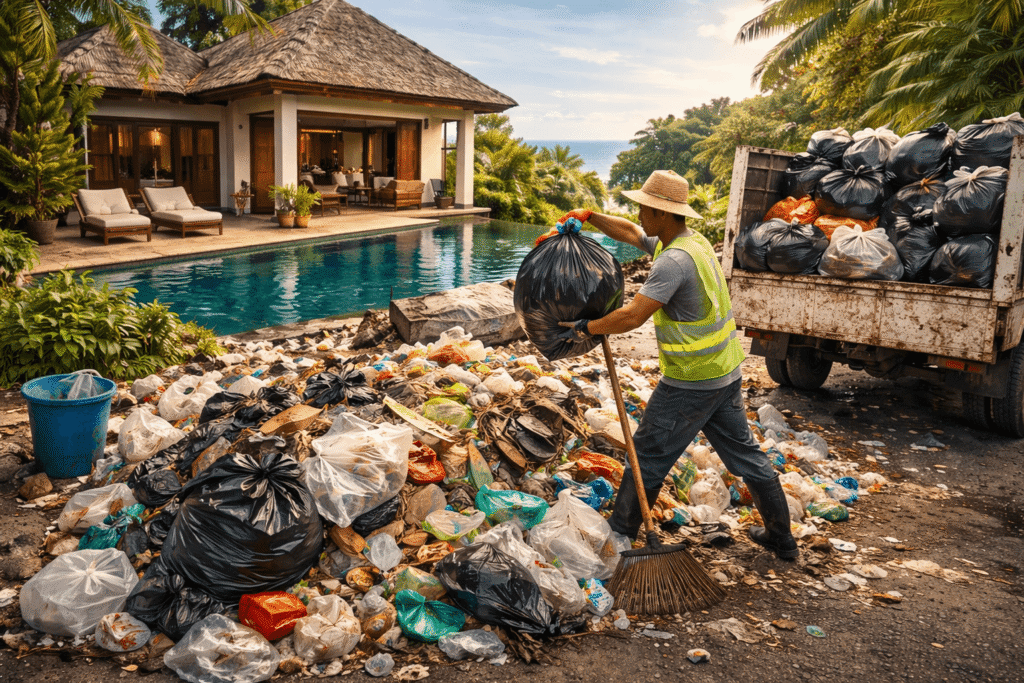
Where Does Villa Waste in Bali Really Go?
The Hidden Problem Investors Can No Longer Ignore
Bali’s waste crisis is no longer just an environmental issue, it’s becoming a serious investment risk. As landfill limitations tighten and waste systems struggle to cope, a critical question emerges: where does the waste from villas actually go? This article uncovers the reality behind Bali’s villa waste management and why smart investors are starting to pay attention.
Where Does Villa Waste in Bali Really Go?
Bali has always sold a dream.
Private villas with infinity pools, rice field views, ocean sunsets, and a sense of escape that keeps millions of visitors coming back every year.
But behind that dream, there’s a growing reality that’s becoming harder to ignore.
Waste.
Not just visible waste on beaches or roads, but the invisible system behind it.
And more specifically:
Where does the waste from Bali’s villas actually go?
For investors, this is no longer a minor operational detail.
It’s becoming a critical factor that can impact returns, reputation, and long-term value.
A System Under Pressure: Bali’s Waste Crisis
For years, Bali relied heavily on centralized landfill systems—most notably the Suwung landfill.
But as capacity limits were reached and operations were restricted, the system began to crack.
The result?
- Irregular waste collection
- Overloaded temporary disposal sites
- Rising operational confusion
- And most visibly… a surge in open waste burning
This isn’t theoretical.
It’s happening daily across many parts of the island.
Villas: The Silent Waste Generators
From the outside, villas represent luxury, cleanliness, and order.
Behind the scenes, they function like small hospitality operations, producing a steady flow of waste every single day.
Typical Waste Streams from Villas
- Organic waste (food scraps, kitchen waste)
- Plastics (bottled water, packaging, toiletries)
- Paper and cardboard
- Garden and landscaping waste
- Cleaning chemicals and detergents
- Occasional renovation debris
A fully occupied villa can easily generate significant daily waste volumes, especially in high-turnover rental models.
Now multiply that across thousands of villas across Bali.
So… Where Does It Actually Go? (The Ground Reality)
The uncomfortable truth is:
there is no single, consistent answer.
Instead, waste follows several fragmented paths.
Private Waste Collectors
Most villas rely on third-party waste collection services.
While convenient, the issue lies in lack of transparency.
- Where is the waste ultimately processed?
- Is it sorted?
- Is it recycled, or simply relocated?
In many cases, villas outsource responsibility…
but not necessarily the solution.
Temporary Disposal Sites (TPS)
Waste is often transported to local collection points.
However:
- Many are operating beyond capacity
- Sorting is minimal or non-existent
- Pickup schedules are inconsistent
This leads to accumulation, odor issues, and tension with surrounding communities.
Open Burning (A Growing Concern)
With limited infrastructure, open waste burning has increased significantly.
This can occur:
- At informal disposal sites
- By collectors under pressure
- Or even at local community levels
The implications are serious:
- Air pollution
- Health risks
- Negative guest experiences
- Long-term environmental damage
Ironically, guests enjoying “fresh air” in a villa may unknowingly be exposed to burning waste nearby.
Illegal Dumping (Worst-Case Scenario)
In some cases, waste ends up:
- In empty land plots
- In rivers
- Eventually flowing into the ocean
This contributes directly to:
- Beach pollution
- Viral negative media coverage
- Damage to Bali’s global image
The Core Problem: A Fragmented System
Bali’s waste challenge isn’t just about volume.
It’s about structure.
There is currently no fully integrated, island-wide system that ensures:
- Traceability
- Accountability
- Consistent standards
Instead, the chain looks like this:
Villa → Collector → Local Site → Unknown Outcome
For investors, this creates a hidden layer of uncertainty.
Why This Matters for Property Investors
This issue is no longer “environmental only.”
It’s directly tied to asset performance.
Guest Experience Is Changing
Today’s travelers are more aware.
They notice:
- Smoke in the air
- Waste along access roads
- Environmental conditions around the property
This directly affects:
- Reviews
- Ratings
- Repeat bookings
Reputation Risk Is Real
Sustainability is no longer optional—it’s expected.
Properties perceived as contributing to environmental issues may face:
- Negative online sentiment
- Lower positioning in booking platforms
- Reduced brand appeal
Property Value & Location Perception
Areas struggling with waste management issues may experience:
- Slower appreciation
- Buyer hesitation
- Reduced long-term demand
Location is still king, but environmental quality is catching up fast.
Future Regulations Are Coming
Government pressure is increasing.
Potential future measures may include:
- Mandatory waste sorting
- Restrictions on burning
- Compliance standards for businesses
Properties that are unprepared may face:
- Operational challenges
- Increased costs
- Legal complications
A New Investment Lens: Waste as a Value Driver
Here’s the shift that many investors are just beginning to see:
Waste management is becoming part of the due diligence process.
Questions that were rarely asked before are now critical:
- Does the villa have a waste management system?
- Are there recycling or composting solutions?
- How is waste handled locally?
- Is the surrounding area well-managed?
This is no longer a niche concern, it’s becoming mainstream.
Emerging Solutions in Bali
Despite the challenges, progress is happening.
On-Site Waste Management
Some villas are implementing:
- Waste separation at source
- Organic composting systems
- Reduced plastic usage
While effective, it requires:
- Staff training
- Operational discipline
- Guest awareness
Professional Waste Management Services
A new wave of providers is offering:
- Structured collection systems
- Recycling programs
- Organic waste processing
This is becoming a key differentiator for higher-end properties.
Community-Based Systems
Certain villages are developing:
- Local waste facilities
- Collective management systems
- Community-driven solutions
Properties located in these areas gain a significant advantage.
Technology & Circular Models
Early-stage innovations include:
- Organic waste processing machines
- Waste tracking systems
- Circular economy initiatives
While still evolving, these solutions point to the future.
The Hard Truth: There Is No Quick Fix
Bali’s waste issue is complex.
It’s tied to:
- Rapid tourism growth
- Infrastructure limitations
- Behavioral patterns
And most importantly:
It requires shared responsibility.
Who Is Responsible?
Not just:
- Government
- Local communities
- Waste collectors
But also:
- Property owners
- Developers
- Investors
- Guests
Because every villa that operates… generates waste.
Smart Strategies for Investors & Owners
Those who adapt early will have the advantage.
Demand Transparency
Know exactly where your waste goes.
Build Internal Systems
Start with simple waste separation.
Choose the Right Partners
Lowest cost is not always the best solution.
Train Staff & Educate Guests
Small actions create meaningful impact.
Position Your Property
Eco-conscious branding is no longer a trend, it’s a market expectation.
From Crisis to Opportunity
Bali’s waste problem is real.
But so is the opportunity.
Properties that address this issue proactively will:
- Stand out in a competitive market
- Attract higher-quality guests
- Build stronger long-term value
- Align with global sustainability trends
And perhaps most importantly:
They will be part of preserving the very asset that makes Bali valuable in the first place.
The question is simple, but powerful:
Where does your villa’s waste actually go?
Because in Bali today…
the answer might matter more than you think.