The Hidden Environmental Challenge Behind the Island’s Rapid Growth
For decades, Bali has been known as a tropical paradise with fresh air, lush landscapes, and a relaxed lifestyle. But behind the beauty, new environmental pressures are emerging. Rising waste problems, increased open burning after the closure of the Suwung landfill, worsening traffic congestion, and shrinking green spaces are beginning to affect the island’s air quality. For global investors, understanding these environmental challenges is becoming increasingly important when evaluating Bali’s long-term sustainability and property market.
Is Bali Losing Its Clean Air? The Hidden Environmental Challenge Behind the Island’s Rapid Growth
For many people around the world, Bali represents something rare: a place where life feels slower, nature still feels alive, and the air seems cleaner than in most cities.
It is one of the few destinations where people come not only for beaches and culture, but also for a sense of well-being. The island has built a powerful global reputation around wellness, nature, spirituality, and a relaxed lifestyle.
For decades, visitors arriving in Bali often describe the same first impression: stepping off the plane and breathing in warm tropical air that feels noticeably different from the polluted cities they left behind.
But today, a quiet shift is beginning to happen.
Bali is still beautiful. The rice fields still stretch across valleys, temples still sit peacefully between mountains and sea, and sunsets remain some of the most spectacular in the world.
Yet beneath that postcard image, a new set of environmental pressures is emerging , and they are beginning to affect something fundamental: the island’s air quality.
This issue may not yet be widely discussed internationally, but it is becoming increasingly visible locally.
For investors, developers, and long-term residents, understanding this emerging environmental challenge is essential for evaluating Bali’s future sustainability.
Bali’s Growth Story: Success That Comes With Pressure
Over the past two decades, Bali has experienced one of the fastest tourism-driven economic expansions in Southeast Asia.
Before the global pandemic, the island welcomed more than 6 million international visitors annually, alongside millions of domestic tourists.
Tourism has brought extraordinary opportunities:
- international investment
- infrastructure development
- a booming hospitality industry
- rapid growth in the villa and property sector
Entire regions that were once quiet agricultural villages have transformed into vibrant tourism hubs.
Areas such as:
- Canggu
- Uluwatu
- Seminyak
- Berawa
- Pererenan
have seen massive growth in villas, restaurants, beach clubs, coworking spaces, and lifestyle developments.
This transformation has positioned Bali as one of the most dynamic property markets in Asia.
However, rapid growth always brings new challenges.
And one of the most complex challenges now emerging is environmental management, particularly in relation to waste and urbanization.
The Waste Challenge: Bali’s Most Visible Environmental Issue
Among the many environmental issues facing Bali today, waste management has become the most urgent.
Like many fast-growing tourism destinations, Bali generates an enormous amount of waste every day.
This waste comes from multiple sources:
- households
- hotels and resorts
- restaurants and beach clubs
- construction projects
- tourism activities
As tourism and population grow, the volume of waste increases accordingly.
For years, a large portion of Bali’s waste was sent to Suwung Landfill, the island’s primary waste disposal site near Denpasar.
But Suwung has long been operating beyond its intended capacity.
Mountains of garbage accumulated over decades, and the landfill gradually became one of the island’s most pressing environmental concerns.
Eventually, authorities began implementing restrictions and partial closures of the landfill as part of broader waste reform efforts.
While this was necessary from an environmental standpoint, it created an immediate challenge: where should all the waste go?
The Rise of Open Burning
When formal waste systems struggle to keep up, informal solutions often emerge.
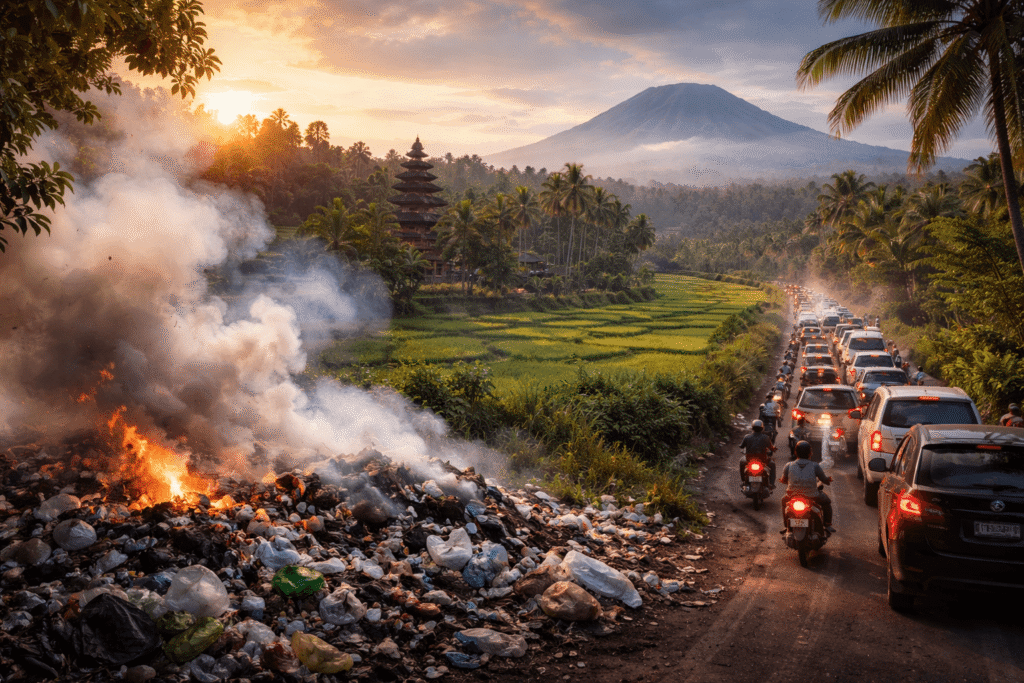
Across various parts of Bali , particularly in residential areas , many households and small businesses have resorted to burning waste as the fastest and simplest disposal method.
This practice is not new, but it has become more noticeable in recent years.
Open burning often occurs in:
- residential compounds
- roadside areas
- empty lots
- rural villages
The problem is that modern waste is very different from traditional organic waste.
Decades ago, most household waste consisted of biodegradable materials.
Today, however, waste streams contain large amounts of:
- plastic packaging
- synthetic materials
- treated wood
- rubber products
When these materials are burned, they release a range of harmful pollutants into the air.
These pollutants include:
- fine particulate matter (PM2.5)
- carbon monoxide
- dioxins
- toxic chemical compounds
These microscopic particles can travel long distances and remain suspended in the air for extended periods.
While Bali’s air quality is still generally better than that of many major global cities, increased burning can gradually degrade air quality if not properly managed.
Air Quality: A Quiet but Important Issue
Unlike plastic pollution on beaches, air pollution is often invisible.
There are no dramatic images of smoky skies or smog-covered skylines like those seen in some major cities.
However, environmental experts often warn that air quality problems can develop gradually and quietly.
Even moderate levels of particulate pollution can contribute to long-term health risks such as:
- respiratory illness
- cardiovascular disease
- asthma
- reduced lung function
For Bali, maintaining clean air is especially important because the island’s identity is closely tied to health, wellness, and nature.
The global wellness tourism market is expanding rapidly, and Bali has positioned itself as one of the world’s leading destinations in this sector.
Yoga retreats, wellness resorts, detox programs, and holistic health experiences have become major components of Bali’s tourism economy.
If environmental quality declines, it could gradually affect the island’s brand.
Traffic Congestion and Vehicle Emissions
Waste burning is not the only factor affecting Bali’s air quality.
Another major contributor is traffic congestion.
Over the past decade, the number of vehicles on the island has increased dramatically.
Motorbikes remain the dominant mode of transportation, but car ownership has also risen sharply.
Tourism growth has added even more traffic through:
- airport transfers
- tour vehicles
- delivery services
- logistics vehicles
- ride-hailing services
Unfortunately, road infrastructure has not expanded at the same pace.
As a result, traffic congestion has become a daily reality in many parts of southern Bali.
Key areas such as:
- Canggu
- Seminyak
- Kuta
- Denpasar
- Uluwatu
often experience significant traffic bottlenecks.
When vehicles remain stuck in slow-moving traffic, emissions increase significantly.
These emissions include nitrogen oxides, carbon monoxide, and particulate pollutants that contribute to declining air quality.
Shrinking Green Spaces
Another environmental factor influencing air quality is the gradual loss of green space.
Bali’s natural landscapes , rice terraces, forests, and agricultural land , have long acted as natural environmental buffers.
Vegetation plays a critical role in maintaining air quality by:
- absorbing carbon dioxide
- filtering pollutants
- producing oxygen
- moderating temperatures
However, rapid development is transforming many previously green areas into built environments.
Villas, resorts, commercial spaces, and residential complexes are expanding across the island.
While development drives economic growth, it also reduces the natural ecosystems that help maintain environmental balance.
Urban planning experts often emphasize that sustainable development requires maintaining a balance between construction and green infrastructure.
Why Investors Should Pay Attention
For global investors considering Bali’s property market, environmental sustainability is becoming an increasingly relevant factor.
In the past, investment decisions in Bali were often driven primarily by tourism demand and rental yields.
Today, however, many international investors are also considering:
- environmental sustainability
- infrastructure development
- long-term livability
These factors influence not only property values but also the long-term attractiveness of a destination.
Destinations that successfully manage environmental challenges often maintain stronger tourism growth and higher property values over time.
In contrast, locations that allow environmental quality to decline may face reputational and economic risks.
Fortunately, Bali still has significant advantages.
The island’s environmental challenges are manageable, and awareness is growing rapidly among government leaders, local communities, and private sector stakeholders.
Positive Signs: Bali’s Growing Sustainability Movement
Despite the challenges, Bali is also home to one of the most vibrant sustainability movements in Southeast Asia.
Many local organizations, businesses, and community groups are actively working on environmental solutions.
Initiatives across the island include:
- zero-waste community programs
- beach cleanup movements
- plastic reduction campaigns
- sustainable tourism initiatives
- regenerative agriculture projects
Several eco-conscious developments are also emerging in the property sector.
Developers are increasingly exploring:
- solar energy
- rainwater harvesting
- sustainable building materials
- waste management systems
- eco-village concepts
For investors, these trends create new opportunities in the green property sector.
Environmentally responsible developments are becoming increasingly attractive to modern travelers and long-term residents.
The Opportunity for Sustainable Development
Rather than viewing environmental challenges purely as risks, many forward-thinking investors see them as opportunities.
Bali is still at a stage where sustainable development can shape the island’s future trajectory.
Some potential areas of opportunity include:
Green residential developments
Eco-friendly villas and communities designed around sustainability principles.
Waste management infrastructure
Investment in recycling facilities, waste-to-energy systems, and circular economy solutions.
Electric mobility infrastructure
Charging networks and electric vehicle adoption.
Green tourism projects
Eco-resorts and regenerative tourism experiences.
As global awareness of climate and environmental issues continues to grow, destinations that prioritize sustainability are likely to attract higher-quality tourism and long-term investment.
The Future of Bali: A Critical Turning Point
Bali today stands at an important crossroads.
The island has achieved remarkable global success as a tourism destination and lifestyle hub.
Few places in the world combine natural beauty, cultural richness, and international appeal as effectively as Bali.
But success brings responsibility.
The decisions made in the next decade will play a major role in shaping Bali’s environmental future.
Key questions include:
- How will the island manage its growing waste challenges?
- Can transportation infrastructure evolve to reduce congestion and emissions?
- Will green spaces be preserved as development continues?
- Can Bali position itself as a global leader in sustainable tourism?
These questions matter not only for residents and policymakers but also for investors.
Protecting the Island’s Most Valuable Asset
In the end, Bali’s greatest asset has never been luxury villas or beach clubs.
Its true value lies in something much more fundamental: its environment.
The island’s natural landscapes, fresh air, and cultural harmony with nature are what have attracted millions of people for generations.
Protecting these qualities is essential for maintaining Bali’s global reputation.
The encouraging news is that awareness is growing.
Environmental issues are now widely discussed among communities, businesses, and policymakers.
Many people recognize that Bali’s future prosperity depends on maintaining the delicate balance between development and environmental stewardship.
A Future Still Full of Possibility
Bali is not facing an environmental crisis yet.
But the early warning signs are visible.
Waste management challenges, open burning, traffic congestion, and shrinking green spaces are issues that require proactive solutions.
For global investors, these challenges should not necessarily be seen as deterrents.
Instead, they highlight the importance of responsible and sustainable investment strategies.
The Bali of the future will likely be shaped by those who understand that long-term success depends on more than short-term growth.
It depends on protecting the island’s environment while supporting its economic vitality.
If Bali can successfully address these challenges, it has the potential to become something even more powerful than it already is:
a global model for sustainable tropical development.
And if that vision becomes reality, Bali will continue to offer what the world has always come here to find , not just beauty and opportunity, but a place where life still feels connected to nature.