
Bali Tightens PMA Access: What Foreign Investors Need to Know About the New OSS Restrictions
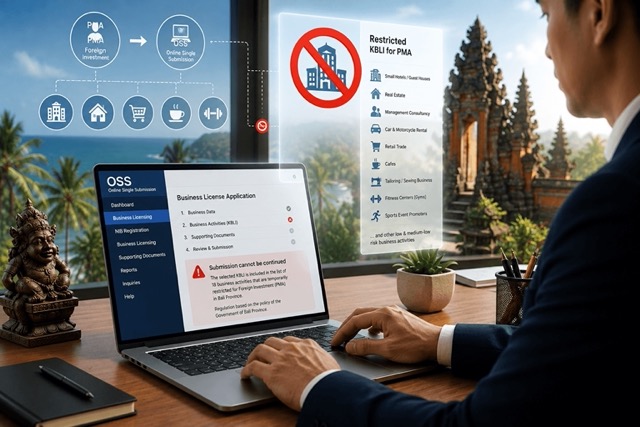
The Bali Provincial Government has officially restricted foreign investment by closing Online Single Submission (OSS) access for Foreign Direct Investment (PMA) companies in 18 low-risk and lower-medium-risk business classifications (KBLI). The policy aims to protect local MSMEs from unfair competition while encouraging higher-quality foreign investment that creates long-term value for Bali. Here’s what has changed, why it matters, and what opportunities remain for investors.
Bali Tightens PMA Access: What Foreign Investors Need to Know About the New OSS Restrictions
Bali has introduced one of its most significant investment policy changes in recent years. Starting from the third week of May 2026, Foreign Direct Investment (PMA) companies are no longer able to apply for new business licences through Indonesia’s Online Single Submission (OSS) system for 18 selected Business Classification Codes (KBLI) categorised as low-risk and lower-medium-risk.
The new policy is not intended to discourage foreign investment. Instead, it aims to ensure that foreign capital contributes meaningfully to Bali’s economy without competing directly with local Micro, Small, and Medium Enterprises (MSMEs).
For anyone planning to invest or establish a business in Bali, understanding this new regulation is now more important than ever.
Why Has Bali Introduced This Policy?
According to Bali Governor Wayan Koster, the decision followed an evaluation that revealed a growing number of PMA companies entering sectors traditionally dominated by local MSMEs.
Authorities found several practices that raised concerns, including:
- Foreign-owned companies operating with only a Business Identification Number (NIB) and little or no actual investment.
- The widespread use of virtual offices without substantial business activities.
- Businesses established with minimal economic contribution.
- Foreign investors entering small-scale sectors that directly compete with local entrepreneurs.
The provincial government believes these practices reduce opportunities for local businesses and undermine the purpose of foreign investment in Bali.
As a result, Bali has decided to tighten access to specific business sectors.
What is the OSS System?
The Online Single Submission (OSS) system is Indonesia’s electronic business licensing platform.
Through OSS, businesses can apply for:
- Business Identification Number (NIB)
- Standard Certificates
- Business Licences
- Operational Licences
Previously, PMA companies could establish businesses in many sectors through OSS, provided they met the applicable requirements.
Under the new policy, however, applications for 18 selected KBLI classifications are no longer available to PMA companies until further notice.
Which Business Sectors Are Affected?
While investors should always refer to the official government regulations for the complete list, the restricted sectors generally include:
- Small hotels and guesthouses
- Certain real estate activities
- Management consultancy services
- Car rental businesses
- Motorcycle rental businesses
- Retail trade
- Cafés
- Tailoring and sewing businesses
- Fitness centres (gyms)
- Sports event promoters
- Several other low-risk and lower-medium-risk business activities.
Most of these sectors have traditionally been dominated by local small businesses.
Does This Mean Bali Is Closing Its Doors to Foreign Investment?
Absolutely not.
This is perhaps the biggest misconception surrounding the new policy.
The Bali Provincial Government has repeatedly emphasised that foreign investment remains welcome. However, the focus is shifting towards investment that delivers long-term economic benefits rather than simply increasing the number of foreign-owned businesses.
The government is encouraging investments that:
- Bring genuine capital investment.
- Create employment opportunities.
- Transfer knowledge and expertise.
- Respect Balinese culture and traditions.
- Support environmental sustainability.
- Strengthen the local economy.
In short, Bali is prioritising quality over quantity.
A New Direction for Foreign Investment in Bali
This policy reflects a broader shift in Bali’s investment strategy.
Rather than allowing foreign investors to enter virtually every business sector, the province is encouraging investment in industries that generate greater value for the island.
These include sectors such as:
- Sustainable tourism
- Wellness and medical tourism
- Digital technology
- Renewable energy
- International education
- Premium hospitality
- Environmental management
- Smart agriculture
- Infrastructure development
The objective is to attract investors who contribute to Bali’s long-term economic growth while preserving its unique cultural identity.
What Does This Mean for Foreign Investors?
For foreign investors, careful planning has become even more important.
Before establishing a PMA company, investors should verify:
- Whether their chosen KBLI remains open to PMA.
- The applicable business risk category.
- Minimum investment requirements.
- Regional regulations.
- Zoning and land-use compliance.
Conducting proper legal and regulatory due diligence before investing can help avoid costly delays or rejected licence applications.
What Does It Mean for Local MSMEs?
The new restrictions are expected to provide greater protection for local entrepreneurs.
Potential benefits include:
- Fairer business competition.
- Increased market opportunities for local businesses.
- More room for MSMEs to expand.
- Reduced competition from foreign-owned small businesses.
- A healthier local business ecosystem.
However, government protection alone will not guarantee success.
Local businesses must continue improving product quality, customer service, digital marketing, and operational efficiency to remain competitive in the long term.
What About Existing PMA Companies?
The current policy primarily affects new business licence applications submitted through the OSS system.
PMA companies that were legally established before the restrictions took effect generally continue operating under their existing licences.
Nevertheless, investors should continue monitoring regulatory developments, as additional implementing regulations or policy updates may be introduced in the future.
Where Are the New Investment Opportunities?
Despite the restrictions, Bali continues to offer numerous attractive investment opportunities.
Some of the sectors expected to remain highly promising include:
- International-standard resorts and hotels
- Wellness and healthcare facilities
- Sustainable tourism projects
- Renewable energy
- Digital businesses
- Premium residential developments
- Tourism-supporting infrastructure
- Waste management and recycling
- Smart farming and agri-tech
- International education services
These industries are considered capable of delivering stronger economic benefits and creating more sustainable growth.
Practical Tips Before Investing in Bali
Anyone considering investment in Bali should take several important steps before committing capital:
- Confirm that the intended KBLI remains open to foreign investment.
- Review the latest OSS regulations.
- Verify land zoning and spatial planning regulations (RDTR).
- Develop an investment structure that complies with Indonesian law.
- Seek advice from experienced legal and investment professionals familiar with Bali’s regulatory environment.
Proper preparation can significantly reduce business risks and improve the likelihood of a successful investment.
Bali’s decision to restrict OSS access for PMA companies in 18 low-risk and lower-medium-risk KBLI classifications does not represent a rejection of foreign investment.
Instead, it signals a strategic shift towards attracting higher-quality investment that generates long-term economic value, supports local communities, and preserves Bali’s unique cultural and environmental heritage.
For foreign investors, this policy highlights the importance of understanding Indonesia’s evolving regulatory landscape before establishing a business. For local MSMEs, it creates greater opportunities to compete and grow in sectors that have traditionally been the backbone of Bali’s economy.
Going forward, success in Bali will depend not only on the size of an investment but also on its ability to create jobs, transfer knowledge, support sustainable development, and contribute positively to the island’s future.
PMA Kini Dibatasi di Bali! Ini 18 Sektor Usaha yang Tak Lagi Bisa Diakses