Can You Build a Villa in a Horticultural Zone?
Many property investors assume that land designated as a horticultural zone cannot be developed. In reality, that is not always the case. Under certain conditions, building a villa may be permitted, provided it complies with local spatial planning regulations, building intensity requirements, and applicable permits. This guide explains the basics of building a villa in a horticultural zone, including KDB and KLB requirements, in a simple and easy-to-understand way.
Can You Build a Villa in a Horticultural Zone? Here’s What You Need to Know
One of the most common questions from property investors in Bali is:
“Can I build a villa on land located in a horticultural zone?”
The short answer is:
Yes, but not in every case.
This is where many investors become confused. Some believe that no construction is allowed at all, while others assume they can freely build a villa just like in tourism or residential zones.
The truth lies somewhere in between.
Every area in Bali follows its own Detailed Spatial Plan (RDTR), which determines how land can be used. Before purchasing land, it is essential to understand what a horticultural zone is and the regulations that apply.
What Is a Horticultural Zone?
A horticultural zone is land primarily designated for growing horticultural crops, such as:
- Fruits
- Vegetables
- Flowers
- Ornamental plants
- Herbs and medicinal plants
- Plant nurseries
The main objective is to preserve agricultural productivity while maintaining green open spaces.
Because agriculture remains the primary land use, large-scale commercial development is generally not the priority.
However, this does not automatically mean that all buildings are prohibited.
Can You Build a Villa?
In certain circumstances, yes.
Villa development may be allowed provided that it complies with:
- Local RDTR regulations
- Spatial planning requirements
- Building regulations
- Environmental standards
- Building Permit (PBG) requirements
- Other permits required by the local government
Most importantly, the development should not significantly reduce or interfere with the agricultural function of the surrounding area.
Since regulations vary between regencies and municipalities, every project should be evaluated based on the specific location.
Never Buy Land Based on Verbal Information Alone
One of the biggest mistakes investors make is purchasing land simply because someone says:
“You can definitely build here.”
Always verify the land by checking:
- Zoning designation
- RDTR regulations
- Road access
- Setback requirements
- Available utilities
- Required permits
A proper due diligence process can save you from costly legal and financial problems.
Understanding KDB (Building Coverage Ratio)
KDB (Koefisien Dasar Bangunan) determines the maximum percentage of land that may be covered by buildings.
For example:
- Land size: 1,000 m²
- KDB: 30%
This means the building footprint may occupy a maximum of 300 m², while the remaining 700 m² must remain as open space.
This regulation helps preserve the green character of horticultural areas.
Understanding KLB (Floor Area Ratio)
KLB (Koefisien Lantai Bangunan) determines the maximum total floor area that can be constructed.
For example:
- Land size: 1,000 m²
- KLB: 0.6
The maximum total floor area would be 600 m².
This could be achieved by:
- A two-storey building of 300 m² per floor, or
- Another configuration, provided both the KDB and KLB limits are respected.
Do All Horticultural Zones Have the Same KDB and KLB?
No.
KDB and KLB values vary depending on the RDTR applicable to each location.
Never assume that regulations from one area apply to another. Always verify the official planning regulations for the land you intend to purchase.
What Type of Villa Works Best?
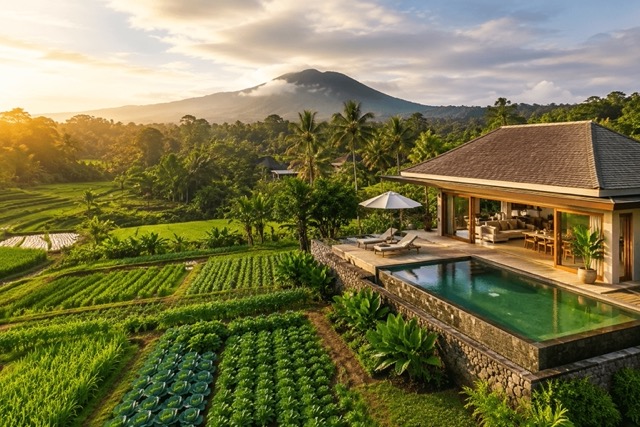
Developments that integrate with the natural landscape are generally more suitable than high-density projects.
Popular concepts include:
- Eco Villas
- Wellness Retreats
- Farm Stays
- Agro-tourism Villas
- Boutique Nature Retreats
- Sustainable Villas with Productive Gardens
These concepts preserve the area’s environmental value while offering attractive investment opportunities.
Common Mistakes Investors Make
Many investors overlook important aspects before buying land, including:
- Not checking the RDTR
- Ignoring KDB and KLB regulations
- Assuming all land can be fully developed
- Overlooking road access requirements
- Failing to consider environmental regulations
- Starting construction before obtaining the necessary permits
These mistakes can lead to expensive redesigns or delays.
Before You Buy Land
To reduce investment risk, always:
- Verify the zoning designation.
- Check the RDTR for the area.
- Understand the applicable KDB and KLB limits.
- Confirm road access and infrastructure.
- Review setback and environmental requirements.
- Consult a qualified architect or planning consultant.
- Secure all required permits before construction begins.
A New Perspective: Smaller Can Be More Valuable
Today’s property market in Bali is changing.
Many travelers are no longer looking for oversized luxury villas. Instead, they increasingly value sustainability, privacy, greenery, and authentic experiences.
Well-designed villas that preserve open space, integrate with nature, and respect local planning regulations often command stronger long-term value and appeal.
Rather than seeing KDB limitations as a disadvantage, smart investors increasingly view them as an opportunity to create premium eco-friendly developments.
Building a villa in a horticultural zone is not automatically prohibited, but it is not automatically permitted either.
Whether a villa can be built depends on the local RDTR, compliance with KDB and KLB requirements, environmental regulations, building permits, and the intended land use.
Before investing, conduct thorough due diligence and ensure the land can legally support your development plans.
A successful property investment is not simply about buying affordable land—it is about purchasing land that can be developed legally, efficiently, and sustainably for long-term value.