
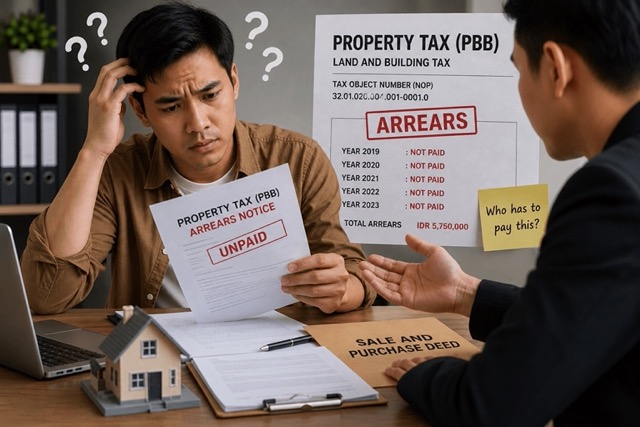
Why Do Old Property Tax Arrears Become the Responsibility of New Land Buyers in Indonesia?
Many property buyers in Indonesia are surprised to discover unpaid Property Tax (PBB) from previous years after purchasing land. Why does a debt created by the former owner often become a practical burden for the new buyer? Isn’t it the government’s responsibility to collect it from the original taxpayer? And what happens if the arrears are ignored? This article breaks down the legal and administrative reality behind Indonesia’s property tax system so investors can avoid costly mistakes.
Understanding the Confusion Around Old Property Tax Debts
Buying land in Indonesia, especially in high-demand markets like Bali, can be an exciting investment move. However, many buyers only discover a hidden issue after the transaction is completed:
Outstanding Property Tax (PBB) from previous years.
At that moment, a common question arises:
“Why should I deal with tax debts that belong to the previous owner?”
On the surface, it feels unfair. After all, the buyer did not own the land during the years the tax was unpaid.
But the answer lies not in fairness, but in how Indonesia structures its property tax system.
PBB Is Attached to the Land, Not Just the Owner
To understand the issue, we need to look at the core principle of Indonesia’s Property Tax system.
PBB (Pajak Bumi dan Bangunan) is not purely a personal tax.
Instead, it is object-based taxation.
This means:
- The tax is attached to the land and building (object)
- Not strictly to the individual owner (subject)
Every land parcel has a Tax Object Number (NOP), and all tax history is recorded under this number.
So when land changes ownership:
✔ The ownership changes legally
✔ But the tax history remains tied to the same NOP
This is why unpaid taxes do not automatically disappear when the land is sold.
Why the New Buyer Gets Pulled Into Old Tax Issues
Even though the legal obligation for past tax periods belongs to the previous owner, in practice the situation becomes more complicated.
There are three main reasons:
Administrative Continuity of the Tax Record
The tax database does not reset when ownership changes.
The system continues tracking:
- Outstanding payments
- Penalties
- Historical arrears
So when the new owner attempts to update records, the unpaid balance still appears.
Land Administration Requirements
In many regions, unresolved PBB can delay or block administrative processes such as:
- Title transfer (name mutation)
- Land splitting or consolidation
- Permit applications
- Transaction verification processes
As a result, the new buyer is often pressured to settle the arrears first—even if they did not create them.
Practical Enforcement Reality
Tax authorities may find it more efficient to enforce payment on the current landholder, because:
- The land is easy to locate
- The NOP is active
- Ownership records are updated
This creates a system where responsibility becomes “attached to the asset” in practice, even if not fully in principle.
Is It Legally Fair? Let’s Break It Down
Legally, the obligation for unpaid tax belongs to the party who controlled the property during that tax period.
However, Indonesian property taxation operates within a hybrid system of:
- Legal liability (who owes it)
- Administrative enforcement (how it is collected)
This creates a gap between law and practice.
So while the former owner is responsible in principle, the new owner may be affected operationally due to administrative systems tied to the land object.
Can the Buyer Claim the Previous Owner?
Yes, this is an important protection mechanism.
If the Sale and Purchase Agreement (SPA/PPJB) includes clear clauses such as:
“All outstanding taxes prior to the transaction date are the responsibility of the seller.”
Then the buyer has legal grounds to:
- Demand reimbursement
- Deduct from purchase price
- Take legal action if necessary
This is why professional transactions always include tax responsibility clauses.
What Happens If PBB Arrears Are Ignored?
Ignoring unpaid property tax is not just a minor issue. Over time, it can create real consequences.
Growing Penalties and Interest
Unpaid tax accumulates fines, increasing the total liability over time.
Administrative Obstacles
Unresolved tax records can delay:
- Title transfers
- Legal certification processes
- Property restructuring
Reduced Property Liquidity
Future buyers may hesitate if tax issues appear in due diligence checks.
Government Collection Measures
Local tax authorities can issue formal collection notices and enforcement actions under regional tax regulations.
Lower Market Value
Properties with unresolved legal or tax issues are often valued lower due to risk perception.
The Hidden Truth Investors Often Miss
Most property buyers focus on:
- Price
- Location
- Access road
- Zoning classification
But experienced investors focus on something deeper:
“The legal and fiscal history of the land.”
Because in reality, when you buy land, you are not only buying physical space—you are inheriting its administrative footprint.
This includes:
- Tax history
- Ownership chain
- Compliance status
- Zoning legality
- Potential disputes
Ignoring this layer is one of the most common mistakes in real estate investment.
How to Protect Yourself Before Buying Land
To avoid inheriting unexpected tax liabilities, always conduct due diligence:
✔ Request PBB receipts (last 3–5 years)
✔ Verify NOP status at local tax office
✔ Confirm no outstanding arrears
✔ Include tax clauses in SPA/PPJB
✔ Work with a legal or property consultant
In markets like Bali, this step is not optional—it is essential risk management.
Strategic Insight: You Are Buying a “History,” Not Just Land
A simple way to understand property investment in Indonesia:
You are not just buying land. You are buying its entire administrative history.
This is why two plots that look identical can carry very different risk profiles.
One may be clean and ready.
The other may carry years of unresolved obligations.
Old property tax arrears in Indonesia remain linked to the land object rather than disappearing when ownership changes. While the legal responsibility for past unpaid taxes belongs to the previous owner, the administrative system often creates practical obligations for the new buyer.
This is not just a tax issue, it is a structural feature of how property administration works.
The safest approach is simple:
- Verify before you buy
- Contractually define responsibilities
- Never assume a clean history without checking
Because in real estate, the real risk is rarely what you see, it is what you don’t see in the paperwork.
Beli Tanah Malah Kena Tunggakan Pajak Lama? Ini Penjelasan Hukumnya