
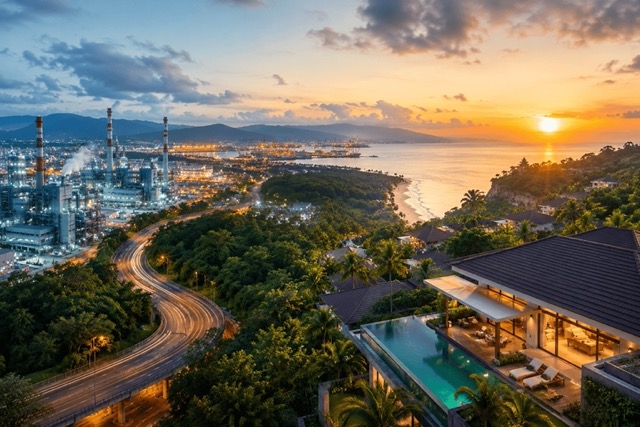
How Economic Growth Could Create New Opportunities for Bali Property Investors
As much of the world continues to grapple with high interest rates, slowing growth, and economic uncertainty, Indonesia is taking a different path. Through its ambitious downstreaming strategy, the country is transforming raw natural resources into higher-value products, attracting billions in investment, creating jobs, and strengthening long-term economic growth. While the effects are most visible in industrial sectors, the impact could extend far beyond factories and mining regions. Bali’s property market may emerge as one of the unexpected beneficiaries of Indonesia’s economic transformation. Could downstreaming become a powerful new driver for Bali real estate? Let’s take a closer look.
Indonesia’s Economic Transformation Is Gaining Momentum
The global economy has faced significant challenges in recent years. High interest rates, persistent inflation concerns, geopolitical tensions, and slower economic growth have caused investors to become increasingly cautious.
Many countries continue to struggle with weak growth prospects and uncertain economic outlooks.
Yet Indonesia has managed to maintain relatively strong economic momentum.
One of the key drivers behind this resilience is the government’s long-term downstreaming strategy, known locally as hilirisasi.
Rather than exporting raw materials and allowing other countries to capture most of the value, Indonesia is increasingly processing its natural resources domestically. This creates higher-value industries, generates employment, attracts investment, and strengthens the country’s position within global supply chains.
The results are becoming increasingly visible.
New industrial zones are emerging. Foreign direct investment continues to flow into manufacturing sectors. Infrastructure development is accelerating. Domestic consumption remains robust.
But what does all of this mean for Bali’s property market?
The connection may not seem obvious at first glance, yet the relationship could become increasingly important over the coming decade.
What Is Indonesia’s Downstreaming Strategy?
In simple terms, downstreaming means processing raw materials into finished or semi-finished products before exporting them.
For decades, Indonesia exported large volumes of raw commodities such as:
- Nickel
- Bauxite
- Copper
- Tin
- Palm oil
- Agricultural products
While these exports generated revenue, much of the value-added processing occurred overseas.
The downstreaming strategy aims to change that.
Instead of exporting raw nickel ore, Indonesia now encourages companies to process nickel domestically into products used for:
- Electric vehicle batteries
- Stainless steel
- Renewable energy technologies
- Industrial manufacturing
This significantly increases the economic value generated from the same natural resource.
As a result, Indonesia is gradually moving up the global value chain.
Why Global Investors Are Paying Attention
The world is undergoing a major transition toward renewable energy and electric vehicles.
Indonesia possesses some of the largest nickel reserves on the planet, making it strategically important for future battery production.
This has attracted substantial international investment from companies seeking long-term access to critical minerals and manufacturing facilities.
Investors are not simply building processing plants.
They are investing in:
- Industrial parks
- Logistics infrastructure
- Energy facilities
- Transportation networks
- Worker housing
- Commercial developments
These investments create economic activity that extends far beyond the industrial sector itself.
Every new factory creates jobs.
Every job supports households.
Every household contributes to consumer spending.
This multiplier effect is one of the reasons economists view downstreaming as a potential game-changer for Indonesia’s long-term growth.
The Rise of a New Industrial Indonesia
Many analysts believe Indonesia is entering a new phase of industrial development.
Unlike previous commodity booms that relied heavily on raw exports, today’s strategy focuses on value creation within the country.
This shift offers several long-term advantages:
Higher Export Value
Processed products command significantly higher prices than raw materials.
Job Creation
Manufacturing industries generally create more employment opportunities than raw commodity extraction.
Technology Transfer
Foreign investment often brings expertise, innovation, and advanced production methods.
Increased Tax Revenue
A larger industrial base generates additional government revenue that can be reinvested into infrastructure and public services.
Stronger Domestic Economy
Higher incomes contribute to greater consumer spending and a growing middle class.
These benefits can create positive ripple effects throughout the national economy.
Downstreaming Creates New Wealth, Not Just New Industries
One aspect often overlooked in discussions about downstreaming is wealth creation.
Industrial growth does not merely generate economic statistics.
It creates successful entrepreneurs, business owners, executives, suppliers, consultants, and investors.
Across Indonesia, a new generation of affluent professionals and business leaders is emerging as industrial activity expands.
These individuals often seek opportunities to diversify their assets.
Historically, real estate has been one of the preferred wealth-preservation and wealth-building vehicles.
And when it comes to premium lifestyle property, Bali remains one of Indonesia’s most attractive destinations.
This may become one of the most important indirect benefits of downstreaming for Bali’s property market.
Why Bali Continues to Stand Out
Bali occupies a unique position within Indonesia and the wider Asia-Pacific region.
Few destinations offer the same combination of:
- International tourism appeal
- Tropical lifestyle
- Strong global brand recognition
- Growing expatriate community
- Attractive rental yields
- Diverse property options
- Relatively accessible investment opportunities
For many investors, Bali represents more than a vacation destination.
It represents a lifestyle asset.
An income-generating asset.
And increasingly, a long-term investment asset.
Stronger National Growth Benefits Bali
Although Bali is not a major industrial hub, it remains deeply connected to Indonesia’s broader economic performance.
When the national economy grows, several factors can support Bali’s property sector:
Increased Domestic Investment
A growing middle and upper class creates additional demand for holiday homes, villas, and investment properties.
Improved Infrastructure
Economic growth enables governments to invest more heavily in transportation, utilities, and public facilities.
Greater Business Confidence
Companies and investors tend to expand more aggressively when economic conditions are favorable.
Higher Tourism Spending
Rising incomes contribute to stronger domestic tourism, complementing international visitor arrivals.
Together, these factors create a supportive environment for property market growth.
Bali’s Property Market Is Becoming More Diverse
One of the most interesting developments in recent years has been the diversification of Bali’s buyer base.
Historically, certain regions depended heavily on buyers from specific countries.
Today, demand is increasingly coming from multiple sources:
- International investors
- Digital entrepreneurs
- Remote workers
- Retirees
- Domestic investors
- Hospitality operators
This diversification helps strengthen market resilience.
The addition of a growing domestic investor class could become another important pillar supporting future demand.
Infrastructure Development Strengthens the Investment Case
Economic transformation typically requires infrastructure expansion.
Indonesia continues investing heavily in:
- Airports
- Roads
- Ports
- Public transportation
- Energy networks
- Digital connectivity
As national infrastructure improves, accessibility across the country improves as well.
For Bali, better connectivity supports tourism growth, business activity, and property development.
Areas that were previously considered remote may become increasingly attractive as transportation networks expand.
What About High Global Interest Rates?
High interest rates remain one of the most discussed challenges facing global investors.
Borrowing costs have increased.
Financing conditions are tighter.
Some property markets around the world have slowed considerably.
However, high-quality assets often continue attracting capital even during uncertain periods.
Investors increasingly prioritize:
- Scarcity
- Location quality
- Rental demand
- Long-term appreciation potential
- Lifestyle value
Bali possesses many of these characteristics.
As a result, demand has remained relatively resilient compared to numerous global property markets facing greater challenges.
The Long-Term Outlook for Bali Property
Looking ahead, several trends could support continued growth in Bali’s property sector.
Growing Domestic Wealth
Downstreaming may create a larger pool of Indonesian investors seeking diversification opportunities.
Expanding Tourism Industry
International arrivals continue recovering and evolving beyond traditional holiday tourism.
Digital Economy Growth
Remote work and digital entrepreneurship continue supporting long-term demand for flexible living environments.
Infrastructure Improvements
Ongoing development projects may unlock new investment corridors across Bali.
Global Lifestyle Appeal
Bali’s reputation as a world-class destination remains one of its strongest competitive advantages.
Could Bali Become an Indirect Winner of Indonesia’s Industrial Success?
The answer is increasingly yes.
While factories and processing facilities may be located hundreds or even thousands of kilometers away, the wealth and investment capital generated by those industries often seek opportunities elsewhere.
Historically, successful economies tend to produce greater demand for premium real estate, lifestyle assets, and investment properties.
Bali is uniquely positioned to benefit from this trend.
The island combines international appeal with investment potential in a way few destinations can match.
Indonesia’s downstreaming strategy represents far more than an industrial policy.
It is a long-term economic transformation designed to move the country higher up the global value chain, attract investment, create jobs, and generate sustainable growth.
While the direct effects are most visible in manufacturing and resource-processing industries, the indirect benefits may spread across the entire economy.
For Bali, this transformation could create new opportunities through rising domestic wealth, stronger infrastructure, increased investment activity, and growing confidence in Indonesia’s future.
At a time when much of the world remains cautious due to high interest rates and economic uncertainty, Indonesia’s downstreaming story offers a compelling reason for optimism.
And for property investors looking toward the future, Bali may remain one of the most attractive places to turn opportunity into reality.