
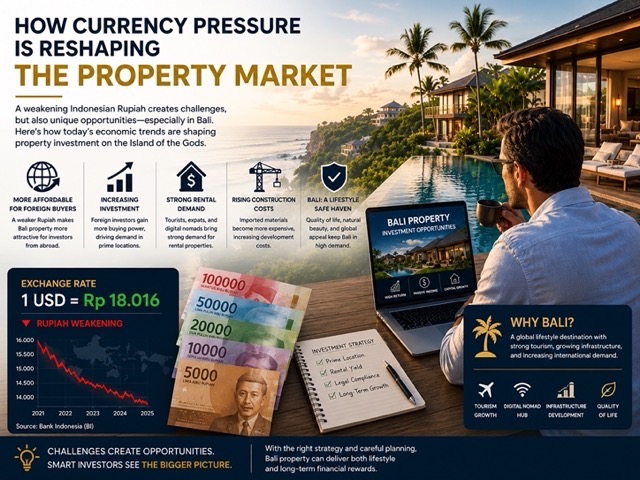
How Currency Pressure Is Reshaping the Property Market
A weakening Indonesian Rupiah is often viewed as a warning sign for the economy. Rising import costs, inflation concerns, and global uncertainty can all create challenges. Yet for Bali’s property market, the story is far more complex. As international investors, digital nomads, retirees, and entrepreneurs continue to flock to the Island of the Gods, a weaker Rupiah may actually strengthen Bali’s appeal as a global real estate destination. Here’s how today’s economic trends are influencing property opportunities across Bali and beyond.
The Weakening Rupiah: Threat or Opportunity?
Whenever the Indonesian Rupiah loses value against major currencies such as the US Dollar, Australian Dollar, Euro, or Singapore Dollar, headlines often focus on the risks.
Imported goods become more expensive.
Businesses face higher operating costs.
Inflationary pressures can increase.
Consumer purchasing power may decline.
While these concerns are real, there is another side to the story, particularly in regions that attract significant foreign investment.
Bali stands out as one of those regions.
Unlike many local property markets that rely primarily on domestic buyers, Bali operates within a truly international ecosystem. Foreign investors, expatriates, retirees, digital nomads, hospitality operators, and international entrepreneurs all play an important role in shaping demand.
As a result, a weakening Rupiah can create both challenges and unique opportunities.
Why Is the Rupiah Under Pressure?
Several global economic factors continue to influence the Indonesian currency.
Higher US Interest Rates
For several years, the US Federal Reserve has maintained relatively high interest rates to combat inflation.
Higher interest rates in the United States attract global capital toward US-based assets, increasing demand for the US Dollar while placing pressure on emerging market currencies such as the Rupiah.
Global Geopolitical Uncertainty
Conflicts, trade tensions, and geopolitical instability around the world have made investors more cautious.
During uncertain times, many investors seek safe-haven assets, with the US Dollar often becoming the preferred choice.
Slower Global Economic Growth
Many economies continue to experience slower growth following the pandemic era.
Reduced international trade, investment activity, and capital flows can affect emerging markets, including Indonesia.
Dependence on Imports
Indonesia still relies on imported materials, machinery, energy, and industrial products.
When the Rupiah weakens, these imports become more expensive, adding pressure to businesses and consumers alike.
How Currency Weakness Impacts Property Markets Globally
The relationship between currency values and real estate markets is not unique to Indonesia.
Countries such as Thailand, Vietnam, Turkey, Portugal, and Mexico have experienced similar dynamics.
Positive Effects
A weaker currency often makes local real estate more affordable for foreign buyers.
International investors can acquire properties at a relative discount when converting stronger currencies into local currency.
Other benefits include:
- Increased foreign investment
- Greater tourism activity
- Higher demand for rental properties
- Stronger appeal of real assets as inflation hedges
Negative Effects
However, there are also challenges:
- Rising construction costs
- More expensive imported building materials
- Higher financing costs
- Reduced affordability for local buyers
The balance between these positive and negative forces determines how each property market responds.
Why Bali Is Different
Bali’s property market operates differently from most regions in Indonesia.
The island has evolved far beyond being simply a tourism destination.
Today, Bali serves as:
- A global lifestyle destination
- A digital nomad hub
- A retirement destination
- An international business base
- A hospitality investment hotspot
- A second-home market for foreign buyers
Because of this international exposure, Bali reacts differently to currency movements compared to many domestic markets.
Foreign Investors Gain More Buying Power
One of the most immediate effects of a weaker Rupiah is increased purchasing power for foreign investors.
Imagine an investor from Australia, Europe, Singapore, or North America.
When the Rupiah weakens against their home currency, Bali properties effectively become less expensive from their perspective.
A villa priced at IDR 10 billion may represent a significantly lower investment when converted into foreign currency than it did previously.
This creates an attractive entry point for international buyers looking to diversify their portfolios.
As a result, foreign interest often rises during periods of currency weakness.
Increased Demand Can Push Property Values Higher
As foreign buyers become more active, demand tends to increase in key investment locations.
Areas frequently attracting international attention include:
- Canggu
- Berawa
- Pererenan
- Uluwatu
- Bingin
- Sanur
- Ubud
- Kedungu
- Cemagi
- Amed
In these areas, land values and villa prices often outperform broader market averages.
Growing international demand creates competition for limited supply, supporting long-term capital appreciation.
The Rental Market Also Benefits
Another important factor is Bali’s rental market.
Tourists, expatriates, and digital nomads generally earn and spend in stronger foreign currencies.
When the Rupiah weakens:
- Bali becomes more affordable for international visitors
- Tourists may stay longer
- Remote workers can extend their stays
- Demand for villas and long-term rentals increases
For property owners, this can translate into:
- Higher occupancy rates
- Improved rental yields
- More stable cash flow
This is one reason why Bali’s hospitality-focused property sector remains attractive despite economic uncertainty.
Rising Construction Costs: The Hidden Challenge
Not every consequence of a weaker Rupiah is positive.
Many building materials and development components have global pricing influences.
Examples include:
- Steel
- Aluminum
- Imported finishes
- Mechanical equipment
- Air conditioning systems
- Electrical components
- Smart-home technologies
As the Rupiah weakens, these items become more expensive.
Developers may face:
- Higher construction budgets
- Reduced profit margins
- Increased project costs
- Longer development timelines
Ultimately, some of these costs are passed on to buyers through higher property prices.
Impact on Local Buyers
While foreign investors may benefit from currency movements, local buyers often face greater challenges.
A weaker currency can contribute to:
- Higher living costs
- Increased inflation
- Reduced purchasing power
- More cautious lending conditions
As household budgets become tighter, some buyers delay property purchases or scale back investment plans.
This creates an interesting contrast where international demand may remain strong while local demand becomes more selective.
Global Economic Trends Shaping Bali’s Future
Several broader economic developments are influencing Bali’s property market beyond currency movements alone.
The Rise of Remote Work
Remote work has fundamentally changed how people live and invest.
Professionals no longer need to live in major business centers to earn global incomes.
Bali has become one of the world’s most popular destinations for:
- Remote workers
- Entrepreneurs
- Freelancers
- Content creators
- Tech professionals
A weaker Rupiah only strengthens Bali’s affordability advantage.
Lifestyle-Driven Investment
Today’s investors increasingly seek more than financial returns.
They also value:
- Quality of life
- Wellness
- Nature
- Community
- Work-life balance
Bali offers a rare combination of these factors, making it highly attractive compared to many competing destinations.
Global Financial Market Volatility
Periods of stock market uncertainty often encourage investors to diversify into real assets.
Property remains one of the most popular choices for wealth preservation and long-term growth.
A New Perspective: Bali as a Lifestyle Safe Haven
One of the most interesting trends emerging today is the concept of “Lifestyle Investing.”
Traditionally, people purchased real estate primarily for financial gain.
Now many investors are looking for assets that provide both returns and personal enjoyment.
A Bali villa can serve multiple purposes:
- Investment property
- Holiday home
- Remote work base
- Retirement residence
- Family retreat
This dual-purpose appeal creates a powerful advantage that many traditional property markets cannot offer.
As global uncertainty increases, lifestyle-focused investments may become even more desirable.
Is There a Risk of a Property Bubble?
This question is frequently raised whenever prices rise rapidly.
While certain micro-markets may experience temporary overheating, Bali’s overall demand continues to be supported by several strong fundamentals:
- Growing international tourism
- Expanding flight connectivity
- Increasing digital nomad arrivals
- Strong hospitality demand
- Continued infrastructure improvements
- Global recognition of Bali as a lifestyle destination
That said, investors should remain selective.
Not every area will perform equally well, and proper due diligence remains essential.
Strategies for Investors in Today’s Market
For those considering Bali property investments, several strategies may help navigate current market conditions.
Focus on Prime Locations
Location remains the most important factor in long-term property performance.
Areas with established demand generally offer greater resilience.
Prioritize Income-Producing Assets
Rental villas, hospitality properties, and long-term accommodation assets can provide both income and appreciation potential.
Pay Close Attention to Legal Structure
Foreign investment regulations and ownership structures require careful planning and professional advice.
Budget Conservatively
Rising construction costs should be incorporated into all financial projections.
Think Long Term
Bali has historically rewarded investors who take a medium- to long-term perspective rather than focusing on short-term market fluctuations.
A weakening Rupiah undoubtedly presents challenges for Indonesia’s broader economy.
However, Bali’s unique position as a global tourism and investment destination creates a different dynamic.
For international investors, the combination of favorable exchange rates, strong tourism demand, growing rental opportunities, and exceptional lifestyle appeal continues to make Bali one of Asia’s most attractive real estate markets.
In many ways, Bali is evolving beyond a traditional property market.
It is becoming a global lifestyle investment destination.
While economic uncertainty remains part of the global landscape, those who understand the underlying trends may discover that periods of disruption often create some of the most compelling investment opportunities.
As the world changes, Bali continues to demonstrate why it remains one of the most sought-after destinations for both living and investing.