
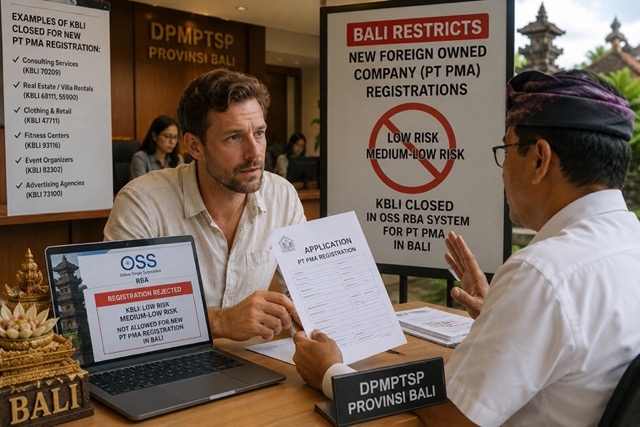
Many PT PMA Businesses Can No Longer Register
Quick Read TL;DR
Bali has begun restricting new PT PMA registrations for several low-risk and medium-low-risk business sectors in the OSS RBA system. Villa rentals, consulting firms, gyms, retail stores, advertising agencies, and event organisers are among the affected industries. Here’s the legal basis, the real impact on foreign investors, and what business owners should prepare for next.

They said it was coming…..
Bali has quietly begun restricting new PT PMA registrations for several low-risk and medium-low-risk business sectors in the OSS RBA system. Villa rentals, consulting firms, gyms, retail stores, advertising agencies, and event organisers are among the affected industries. Here’s the legal basis, the real impact on foreign investors, and what business owners should prepare for next.
For years, Bali has been one of Southeast Asia’s biggest magnets for foreign investment.
From villa rentals and property management to gyms, consulting agencies, fashion retail, digital marketing companies, and event organisers, foreign-owned businesses have grown rapidly across the island.
But in 2026, the direction appears to be changing.
The Bali Provincial Government, together with DPMPTSP, has started restricting new PT PMA registrations for several business classifications categorised as Low Risk and Medium-Low Risk under Indonesia’s OSS RBA licensing system.
This policy has quickly become a major topic among foreign investors because many popular business sectors can no longer be registered under new PT PMA applications in Bali.
Several affected KBLI classifications reportedly include:
- Consulting Services (KBLI 70209)
- Real Estate / Villa Rentals (KBLI 68111 & 55900)
- Clothing & General Retail (KBLI 47711)
- Fitness Centres (KBLI 93116)
- Event Organisers (KBLI 82302)
- Advertising Agencies (KBLI 73100)
So what exactly is happening?
The Legal Basis Behind Bali’s PT PMA Restrictions
This is not simply a rumour circulating in the market.
There are several legal and administrative foundations behind the policy.
Bali Provincial Government Letter
The restriction reportedly refers to:
Letter Number B.27.000/642/PM/DPMPTSP
issued through Bali’s DPMPTSP office.
The letter requested adjustments within the OSS RBA system related to certain KBLI classifications for new PT PMA registrations in Bali.
Although a regional administrative letter is not equivalent to a national law, in practice, it can strongly influence technical implementation and licensing coordination within the OSS system.
Government Regulation Number 28 of 2025
The main national legal basis is:
Government Regulation Number 28 of 2025 concerning Risk-Based Business Licensing Implementation
This regulation serves as the core framework for Indonesia’s OSS RBA licensing system.
Within its attachments, every KBLI business classification in Indonesia is categorised according to business risk levels:
- Low Risk
- Medium-Low Risk
- Medium-High Risk
- High Risk
These classifications determine:
- licensing requirements,
- supervision levels,
- certification obligations,
- and operational compliance standards.
Why Is Bali Restricting Low-Risk Foreign Businesses?
This is the biggest question.
After all, low-risk sectors have traditionally been the most popular industries for foreign investors entering Bali.
Several reasons appear likely.
Bali May Be Experiencing an Oversupply of Foreign-Owned Businesses
Over the past several years, foreign business growth in Bali has expanded aggressively.
In many tourism areas:
- villa developments exploded,
- coworking spaces multiplied,
- wellness centers and gyms increased rapidly,
- foreign-run agencies became more common,
- and small retail businesses expanded aggressively.
This growth created concerns regarding:
- unhealthy competition,
- pressure on local SMEs,
- land-use imbalance,
- zoning conflicts,
- and social-economic inequality.
Bali’s government now appears to be shifting toward more selective investment control.
The Government Wants Higher-Quality Investment
There are strong indications that Bali now wants to prioritise investment in sectors such as:
- technology,
- healthcare,
- infrastructure,
- renewable energy,
- education,
- manufacturing,
- and industries with higher economic value.
As a result, Medium-High Risk and High-Risk KBLI sectors are becoming more favourable for new PT PMA registrations.
The message seems clear:
“fewer investors, but larger long-term economic impact.”
Compliance Enforcement Is Likely to Increase
DPMPTSP has also reportedly indicated that existing companies operating under affected KBLI classifications may face:
- stricter inspections,
- compliance audits,
- operational reviews,
- tax verification,
- and licensing checks.
This is particularly important because many Bali businesses grew rapidly during recent years, but not all were structured with proper compliance.
Will Existing PT PMA Companies Be Shut Down?
At this stage, there is no indication that existing PT PMA companies will automatically lose their licenses.
However, existing businesses may experience:
- increased monitoring,
- operational verification,
- tax inspections,
- business activity validation,
- and stronger regulatory supervision.
Companies operating with:
- improper nominee structures,
- mismatched KBLI activities,
- problematic virtual offices,
- or incomplete tax reporting,
could face a significantly higher risk moving forward.
Major Impact on Bali’s Villa Rental Sector
One of the most affected industries is clearly villa rental and property management.
For years, many foreign investors used PT PMA structures to:
- manage villas,
- operate short-term rentals,
- develop hospitality businesses,
- and participate in Bali’s booming tourism property market.
Now the sector appears to be under tighter scrutiny.
This likely relates to:
- overdevelopment,
- zoning violations,
- illegal construction,
- land conversion issues,
- and growing overtourism concerns.
Bali appears to be attempting a major reset in how tourism property growth is managed.
Can Foreigners Still Do Business in Bali?
Yes, absolutely.
But business strategy may need to evolve.
Foreign investors now need to:
- select KBLI classifications more carefully,
- understand risk categories,
- improve compliance,
- prepare stronger legal structures,
- and focus on businesses with a larger economic contribution.
The era of easily opening small foreign-owned businesses in Bali may slowly be changing.
What Should Investors Do Now?
Several steps are becoming increasingly important.
Audit Your KBLI Classification
Make sure your actual business activities fully match your registered KBLI categories.
Review OSS Compliance
Ensure that:
- your NIB remains active,
- Standard Certificates are valid,
- operational licenses are complete.
- OSS reporting is updated properly.
Strengthen Tax Compliance
This is critical.
Whenever government supervision increases, taxation usually becomes one of the main focus areas.
Verify Property Legality
For villa and property businesses, especially:
- zoning,
- PBG permits,
- SLF certification,
- tourism licensing,
- and operational permits
should all be carefully reviewed.
Avoid Grey-Area Structures
Bali appears to be moving toward stricter enforcement.
Business structures that previously operated in legal grey areas may become significantly riskier.
Is This the End of Foreign Investment in Bali?
Not at all.
Bali remains one of Asia’s most attractive investment destinations.
But the investment landscape is evolving.
The government appears to want:
- more sustainable development,
- stronger compliance,
- better environmental balance,
- more benefits for local communities,
- and investment aligned with Bali’s long-term spatial planning.
For serious investors, this may actually become positive news.
Because clearer regulation often creates:
- healthier competition,
- more stable markets,
- stronger long-term property value,
- and better business sustainability.
The restriction of new PT PMA registrations for Low Risk and Medium-Low Risk KBLI sectors in Bali may become one of the island’s most important regulatory shifts in recent years.
The main legal foundations refer to:
- Letter Number B.27.000/642/PM/DPMPTSP
- and Government Regulation Number 28 of 2025 regarding Risk-Based Business Licensing.
While this is not a total ban on foreign investment, Bali’s policy direction clearly appears to be shifting:
from rapid growth toward more controlled and selective investment.
For investors and business owners, now is the right time to:
- review compliance,
- strengthen legal structures,
- improve reporting,
- and prepare for a more regulated business environment.
Because in Bali today, legality is no longer just paperwork.
It is becoming a core part of long-term business survival.