The New Future of Property Investment
Bali’s property market is entering a new era. As spatial planning regulations become stricter and global travelers shift toward sustainability-focused lifestyles, eco development is emerging as one of the strongest future trends in Bali real estate. From eco villas to wellness retreats and green communities, investors are no longer chasing fast profits alone, they are looking for long-term sustainability, environmental value, and future-proof assets. Could eco development become the next big chapter of Bali property investment?
Bali Spatial Planning and Eco Development: The New Future of Property Investment
For years, Bali has been one of the world’s most attractive property investment destinations.
Luxury villas, boutique resorts, cafés, beach clubs, co-working spaces, and tourism developments grew rapidly across the island as tourism exploded.
But lately, something has started to change.
Bali is entering a new phase , one where sustainability, environmental awareness, and spatial planning are becoming increasingly important in shaping the future of property investment.
At the same time, global travelers are changing too.
People today are no longer searching only for luxury buildings or Instagrammable locations. More travelers now value:
- Nature
- Wellness
- Sustainability
- Quiet environments
- Authentic experiences
- Eco-conscious living
- Long-term lifestyle quality
This shift is creating a powerful new trend in Bali:
Eco Development.
And many investors believe this could become the future of Bali real estate.
Bali Is Facing a Turning Point
In the past, many investors entered Bali with a simple mindset:
“Build fast, rent fast, profit fast.”
But today, the market is becoming more complex.
Several areas are now facing growing pressure:
- Traffic congestion
- Water shortages
- Overdevelopment
- Waste management problems
- Environmental degradation
- Land conversion issues
- Stricter building regulations
As a result, investors are starting to think differently.
Instead of only asking:
“Which area is trending?”
They are now asking:
- Is this area sustainable long term?
- What is the zoning status?
- Will regulations become stricter here?
- Will this property still be attractive in 10–20 years?
- Can this development survive future environmental challenges?
These questions are pushing eco development into the spotlight.
What Is Eco Development?
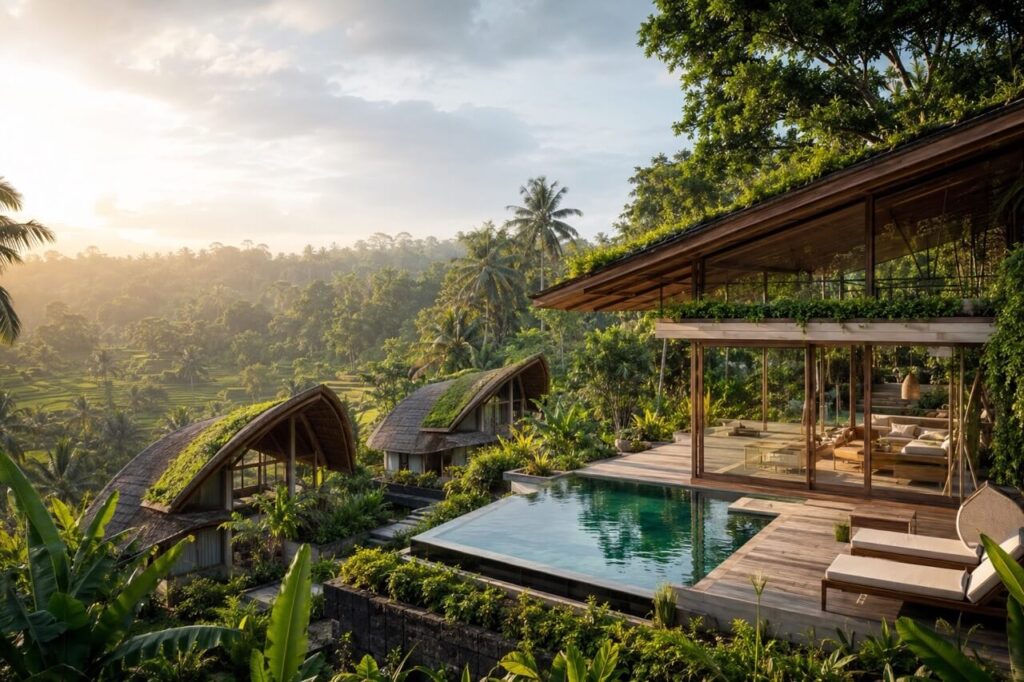
In simple terms, eco development refers to projects designed to balance business profitability with environmental sustainability.
In Bali’s property sector, eco developments often include:
- Natural integration with the landscape
- Reduced environmental impact
- Green open spaces
- Sustainable architecture
- Local and natural materials
- Better water management
- Energy efficiency
- Waste reduction systems
- Cultural sensitivity
- Lower building density
This concept is increasingly visible in:
- Eco villas
- Wellness resorts
- Glamping projects
- Sustainable hospitality
- Eco communities
- Retreat centers
- Slow living developments
And importantly:
the market is responding positively.
Travelers Are Paying More for Nature and Wellness
Today’s global travelers are evolving.
Many tourists no longer want crowded tourist zones all the time. Instead, they seek:
- Peaceful environments
- Wellness experiences
- Authentic culture
- Green landscapes
- Nature immersion
- Health-focused lifestyles
This trend is especially strong among:
- European travelers
- Australian visitors
- Digital nomads
- Wellness travelers
- Long-stay tourists
- Remote workers
Interestingly, many eco resorts and sustainable villas in Bali are achieving strong occupancy rates despite being located outside mainstream tourism hotspots.
Why?
Because people are willing to pay more for experiences that feel healthier, calmer, and more meaningful.
Investors Are Now Thinking About Longevity
One of the biggest shifts happening in Bali’s property market is the move from short-term thinking toward long-term sustainability.
In the past:
“Fast return on investment” was everything.
Now investors increasingly ask:
- Will this asset remain relevant in the future?
- Is the surrounding environment protected?
- Will the area maintain its appeal?
- Is the project aligned with future regulations?
This is important because overdeveloped areas may eventually face:
- Stricter government controls
- Infrastructure stress
- Environmental decline
- Oversupply problems
- Reduced tourism appeal
Meanwhile, sustainable developments often have stronger long-term positioning.
Spatial Planning Could Become the Most Important Investment Factor
Many buyers still purchase land in Bali based only on:
- Cheap pricing
- Viral locations
- Beautiful views
- Social media hype
But the real game changer is increasingly becoming:
Spatial planning.
Bali’s zoning and land-use regulations may soon become one of the biggest determinants of property value and investment security.
Authorities are paying closer attention to:
- Green zones
- Agricultural land
- Conservation areas
- River setbacks
- Coastal setbacks
- Building density
- Height restrictions
- Water catchment areas
Investors who understand spatial planning early usually face significantly lower risks compared to investors simply following market hype.
Eco Development May Become Bali’s New Premium Market
An interesting shift is already happening.
Eco-friendly developments are slowly moving from niche products into premium market assets.
Why?
Because genuine green environments are becoming increasingly rare.
Areas that still offer:
- Natural scenery
- Low-density surroundings
- Fresh air
- Strong environmental quality
- Quiet lifestyles
may become far more valuable in the coming years.
And in real estate:
scarcity creates value.
This is why some eco developments are now positioned more exclusively than conventional luxury villas.
Wellness Tourism and Eco Property Are Becoming Connected
Another major trend influencing Bali is the rise of wellness tourism.
Bali is no longer just a vacation island.
It has become a destination for:
- Healing
- Yoga retreats
- Meditation
- Slow living
- Remote work lifestyles
- Mental wellness
- Healthy communities
And almost all of these concepts naturally align with eco development.
As a result, many investors are now combining:
- Sustainable architecture
- Wellness concepts
- Nature-based experiences
- Eco hospitality
- Community living
into entirely new business models.
Areas Likely to Benefit from This Trend
Several regions in Bali are increasingly attracting attention due to their compatibility with eco development concepts, including:
- Ubud
- Sayan
- Tabanan
- Sidemen
- Kintamani
- Munduk
- Nyanyi
- Parts of North Bali
This does not mean mainstream areas like Canggu or Seminyak will disappear.
Instead, Bali’s property market may become more segmented:
- Dense lifestyle zones for entertainment and nightlife
- Green zones for wellness and eco living
Both can thrive, but for different markets.
The Challenges of Eco Development
Of course, eco development is not without challenges.
Some common obstacles include:
Higher construction costs
Sustainable materials and eco-conscious designs often require higher upfront investment.
Regulations are still evolving
Not all policies fully support green development yet.
“Fake eco marketing”
Some projects use sustainability labels only for branding purposes.
Infrastructure limitations
Certain greener areas still lack infrastructure and accessibility.
Yet these challenges also create opportunity.
Because many investors still do not fully understand this market shift, early movers may have significant advantages.
A New Generation of Investors Is Emerging
Today’s younger investors often think differently.
They are not focused solely on:
- ROI
- Occupancy
- Capital gains
They also consider:
- Environmental impact
- Brand identity
- Sustainability
- Long-term relevance
- Community value
This mindset is helping eco development become increasingly mainstream.
The Future of Bali Property May No Longer Be About “Who Builds the Biggest”
Instead, it may become about:
- Who builds more sustainably
- Who understands spatial planning better
- Who preserves environmental quality
- Who creates long-term value
- Who adapts to changing global lifestyles
And this could reshape Bali’s entire property industry over the next decade.
Bali’s property market is entering a major transition.
The era of uncontrolled development is slowly shifting toward a future built around sustainability, smarter spatial planning, and long-term environmental awareness.
Spatial planning is no longer just a government document.
It is becoming one of the most important factors influencing future investment success.
At the same time, eco development is evolving from a niche trend into a serious market demand.
For investors who can understand this shift early, the opportunities may still be enormous.
Because the future of Bali property may no longer be about building more.
But about building smarter.